
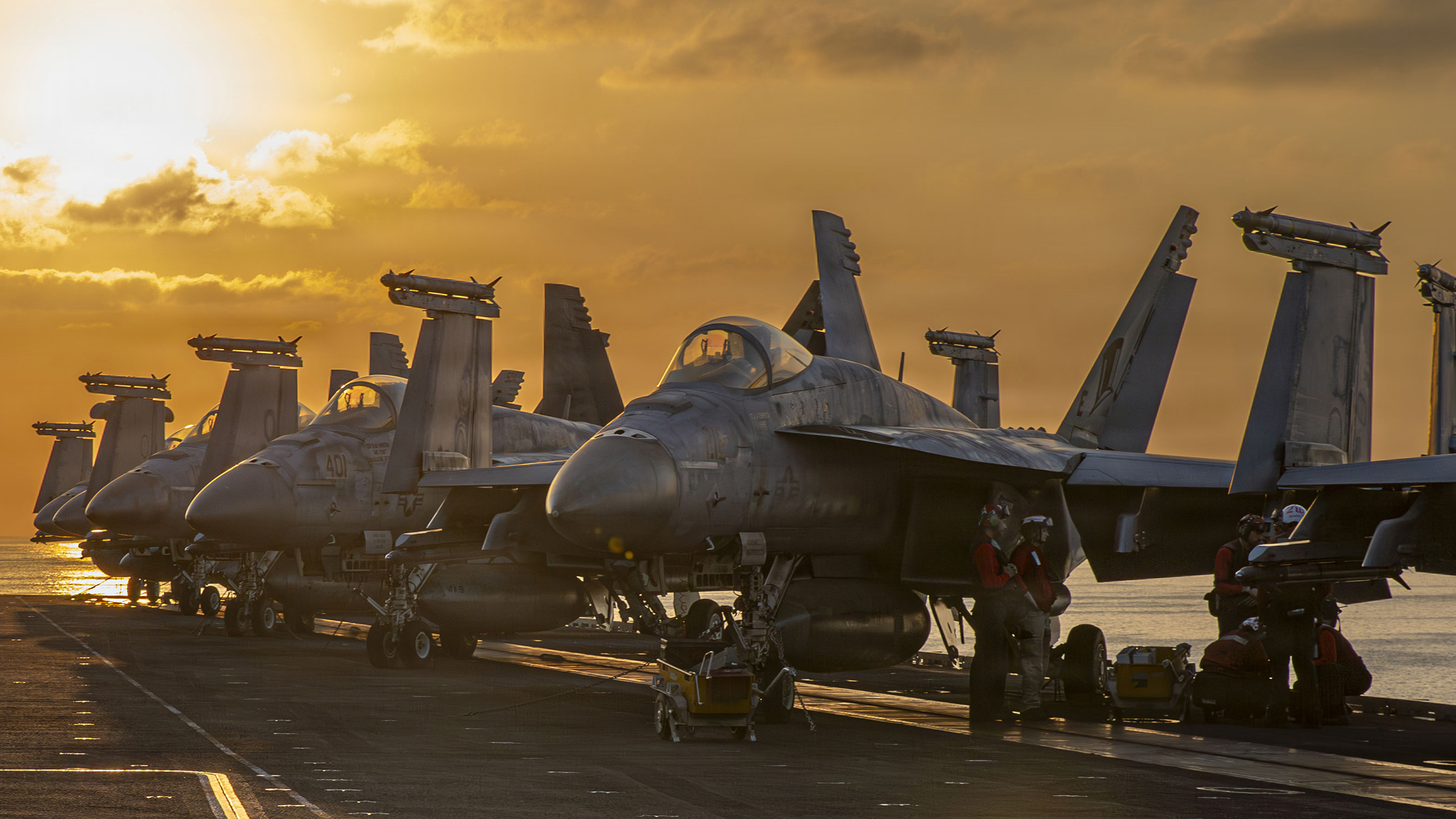
Defense Secretary Pete Hegseth declined to say how long U.S. military operations against Iran might last, a day after President Donald Trump indicated the conflict could be nearing its end.
During a Pentagon news conference on Tuesday, a reporter asked Hegseth to provide his assessment on how far the U.S. military is into its campaign against Iran, dubbed Operation Epic Fury.
Hegseth replied that Trump will determine what objectives need to be achieved and what the conflict’s end state will be.
“He gets to control the throttle,” Hegseth said. “He’s the one deciding — he’s the one elected on behalf of the American people — when we’re achieving those particular objectives. And so, it’s not for me to posit whether it’s the beginning, the middle or the end. That’s his, and he’ll continue to communicate that.”
Top Stories This Week
Hegseth added that the U.S. military provides Trump with daily updates on military operations against Iran “so he can make that determination on the throttle.”
On Monday, Trump said the Iran war “is going to be ended soon,” but he added, “If it starts up again, they’ll be hit even harder.”
Trump did not specify exactly how soon he expects the war against Iran to end, but he added that he doesn’t expect it to be over next week.
Trump’s latest estimate about how long military operations against Iran could last comes after he told reporters on March 2 that Operation Epic Fury could last a month or longer.
“We projected four to five weeks, but we have capability to go far longer than that,” Trump said at the White House while awarding three soldiers Medals of Honor.
Since operations against Iran began on Feb. 28, the U.S. military has attacked more than 5,000 targets, Air Force Gen. Dan. Caine, chairman of the Joint Chiefs of Staff, told reporters on Tuesday.
More than 50 Iranian naval ships have been destroyed so far, including a drone carrier, Caine said during Tuesday’s Pentagon news conference. He also said that Iran’s ballistic missile and drone attacks have decreased 90% and 83% respectively since the start of the conflict.
But even though a number of top Iranian leaders have been killed, including the former Supreme Leader Ayatollah Ali Hosseini Khamenei, the Iranian regime has shown no signs of accepting Trump’s demand for “unconditional surrender.”
Iran has also been able to continue to launch attacks against Israel and other countries in the Middle East, including some that host U.S. troops, such as Bahrain, Qatar, and Kuwait. U.S. officials have yet to say publicly how many American military installations in the region have been attacked or how badly they have been damaged.
A total of seven U.S. service members have been killed in two separate Iranian attacks since the war began. Six Reserve soldiers assigned to the 103rd Sustainment Command were killed in a March 1 drone attack on the Port of Shuaiba, Kuwait. A seventh soldier died of his wounds on March 8 after being seriously injured a week earlier during an attack on Prince Sultan Air Base, Saudi Arabia.
On Tuesday, Hegseth told reporters that the ongoing campaign against Iran “is not 2003,” referring to the U.S.-led invasion of Iraq to oust dictator Saddam Hussein, which turned into a prolonged conflict that lasted for more than eight years.
“We’re not allowing mission creep,” Hegseth said. “The president has set a very specific mission to accomplish, and our job is to unrelentingly deliver that.”

Task & Purpose Video