
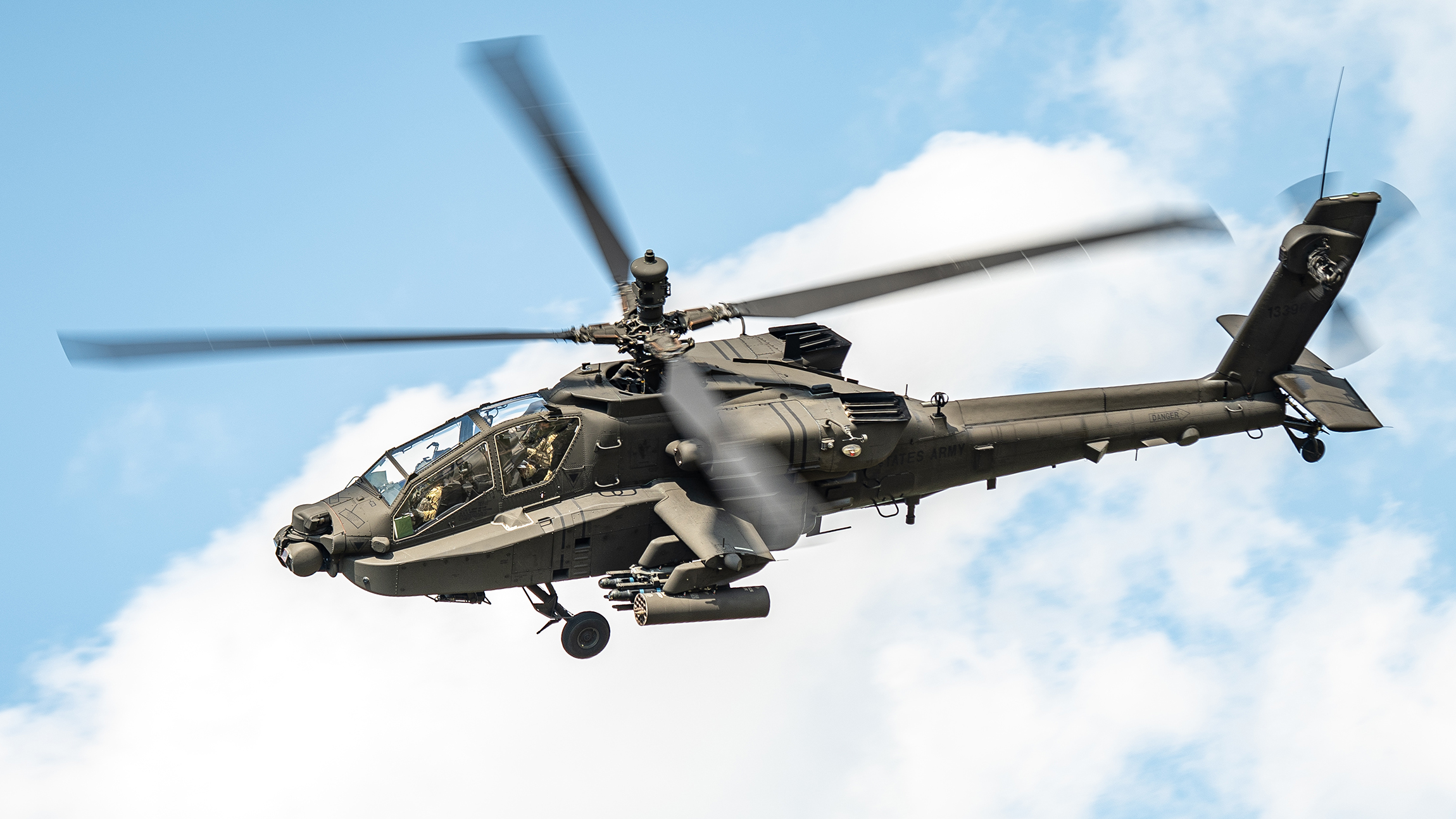
Pilots who fly Apache helicopters for the Army are fiercely dedicated to their mission of watching over and defending forces below on the ground. But in the heart of every Apache pilot is a secret yearning: to find an air-to-air target and blow it out of the sky.
This week, the United Arab Emirates Ministry of Defense released video of their own AH-64s engaging and shooting down Iranian Shaheed drones that it said were headed towards targets in the country. The Israeli Army has also used AH-64s to attack Iranian drones in flight in recent months.
“As Apache pilots, we love to blow things up, and the idea that we can do air-to-air stuff is pretty amazing,” said Don Bentley, who flew Apaches for 10 years in the Army, including in Afghanistan with the 4th Infantry Division, and now writes military novels.
Bentley and another long-time Apache pilot told Task & Purpose that the UAE engagements show how the 40-year-old helicopter has a place in the new world of drone warfare.
Emily Hills enlisted in the army as a truck mechanic but flew the helicopters for 10 years as a warrant officer, including on combat deployments and as a test pilot, retiring in 2018.
“I love the Apache. She’s a maintenance pilot’s worst nightmare, but I love her. So to see the fact that it could calculate that [engagement] is amazing,” Hills said. “I’ve always joked that, you know, the reason that we sell so many aircraft is that we hope there’s an Apache-Apache dog fight someday. We clearly don’t really want that, but it was neat to see.”
Tactics designed for ground used in the air
Both pilots agreed the videos appear to be real, with on-screen symbols that match Apache targeting and flight systems and tell-tale signs of tactics and weapons that match their own experience.
The engagement appears to show Apaches tracking and firing at Iranian Shaheed drones, which have been widely used in the ongoing conflict between the U.S., Israel, and Iran.
Bentley said that, not surprisingly, the Apaches appear to be using their 30mm M230 chain gun, which pivots underneath the nose of the helicopter, with tactics similar to ground engagements.
“What you see in the video is the 30 millimeter cannon that the Apache has,” Bentley said. “It is not designed for air-to-air engagements. It actually fires at a much slower rate than what a fighter jet would. So, for instance, while a fighter cannon might fire 3,000 rounds per minute, the Apache one fires just at 600. Most of those look like 10-round bursts, which is what the cannon is designed for, to shoot armor and stuff.”
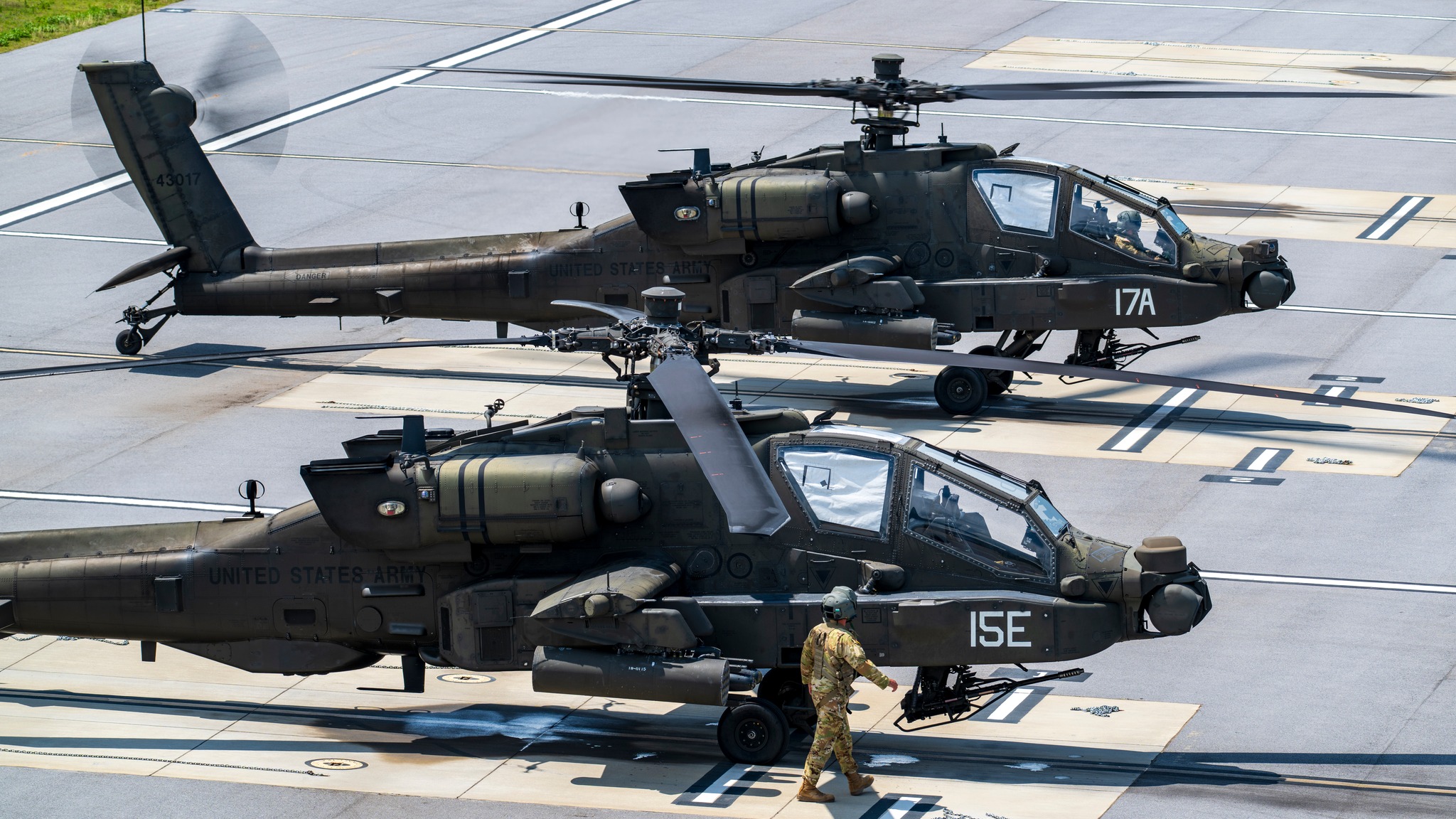
Apaches do not fire tracer rounds, Bentley pointed out, because the guns are targeted with a forward-looking infrared, or FLIR, system, allowing the weapons officer to see each round’s heat signature.
“The gunner was in the FLIR mode so [the bullets] looked black but were actually the heat from the rounds,” Bentley said. “Tracers are for a higher rate of fire machine gun, where you’re ‘walking’ the rounds in. With the Apache, what you’re doing is firing a select number of rounds, and then you adjust the rounds based on the impact. So you’re not firing a continuous stream, like when you walk in tracers.”
Though it doesn’t appear to have been used in this instance, the U.S. has been testing air-burst ammunition designed specifically for taking out drones.
“You can look at the video and see, there’s a couple of those shots where you can see the rounds going by and they’re not air bursting,” Bentley said. “They’re going straight past the target. So I think they’re the normal Apache rounds.”
Hills noted that American Apache pilots preferred firing short bursts in cities in Iraq and Afghanistan.
“If you’re shooting rounds over a populated area, conservation of ammunition is important for collateral damage,” she said. “So I thought it was a really skillful professional engagement.”
Hard flying to set up an easy shot
Hills noted that while the gun is being targeted by the pilot in the front seat, the pilot in the rear is likely pushing the helicopter at close to top speed to stay in the best spot for firing. She also noted that watching the full-throttle engagement made her think of the maintenance troops that had the helicopter’s multiple systems working properly.
“The back seater is doing an amazing job of keeping a level weapons firing platform, which is the job of the back seater,” she said. “I know that aircraft is extraordinarily well maintained, that gun was shooting nails, which, especially in the desert, is extremely difficult to get it to do that. You know, the M230 is a fickle girl.”
Hills also wondered if the mechanics might actually be Americans working as contract workers.
“A lot of the guys I was in the Army with got out and went over there,” she said. “So it still makes me extraordinarily proud of them, because they’re still turning wrenches and still in the fight.”
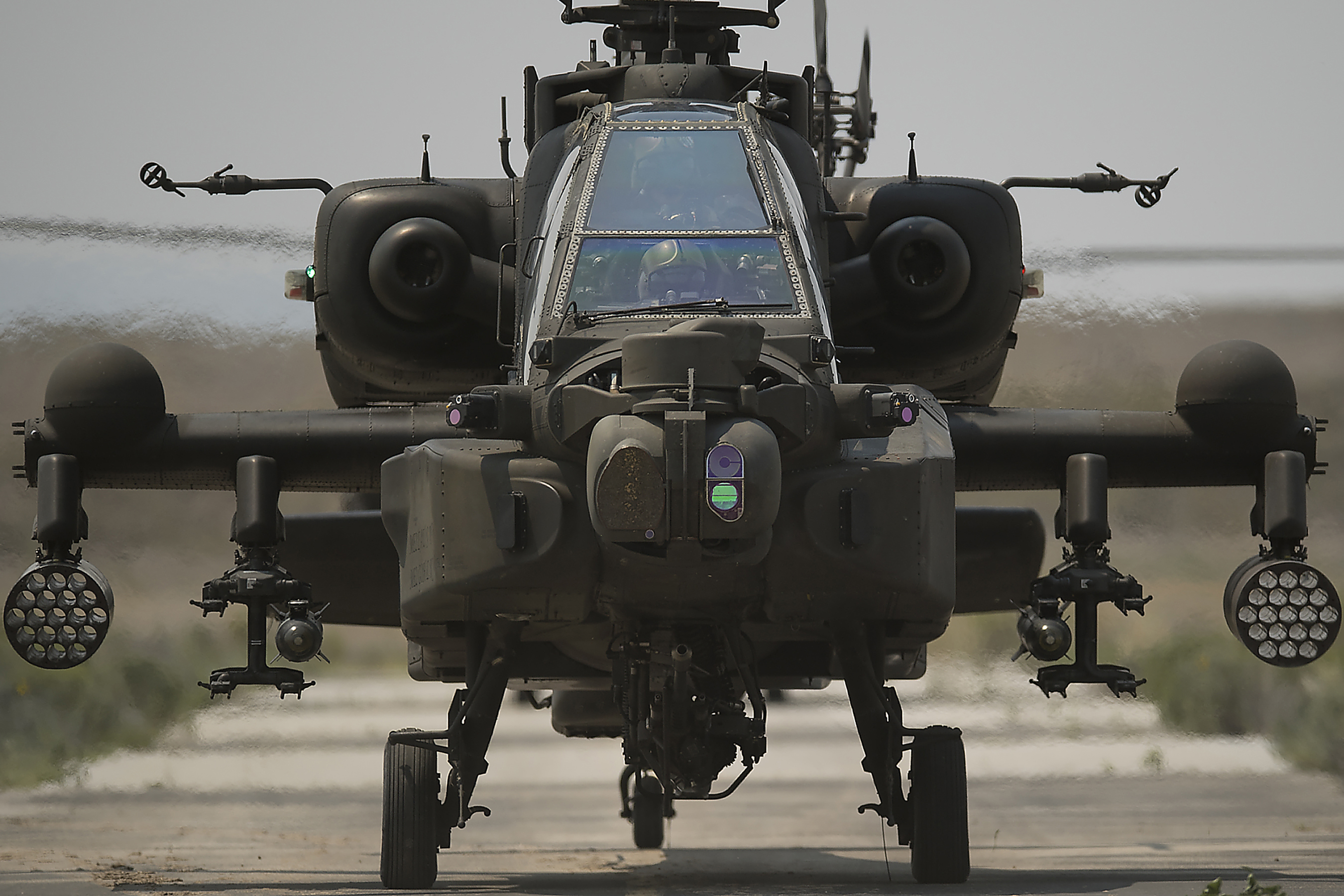
The UAE has flown Apaches for close to three decades and bought over 30 of the latest versions of the helicopter in 2024.
“I trained and went to school with UAE pilots,” Hills said. “They were in our flight classes when I was going through.”
The sheer novelty of seeing an Apache air-to-air kill reminded both pilots that the helicopters were originally conceived with the ability to carry Stinger missiles, a weapon designed to bring down a fighter jet. Early Apache models even had firing switches for the air-to-air system on the flight controls.
“It was envisioned that there would be hard points on the end of the two Apache wing stores where you could potentially mount a Stinger,” said Bentley. “I never used it in 10 years of flying.”
Task & Purpose Video