
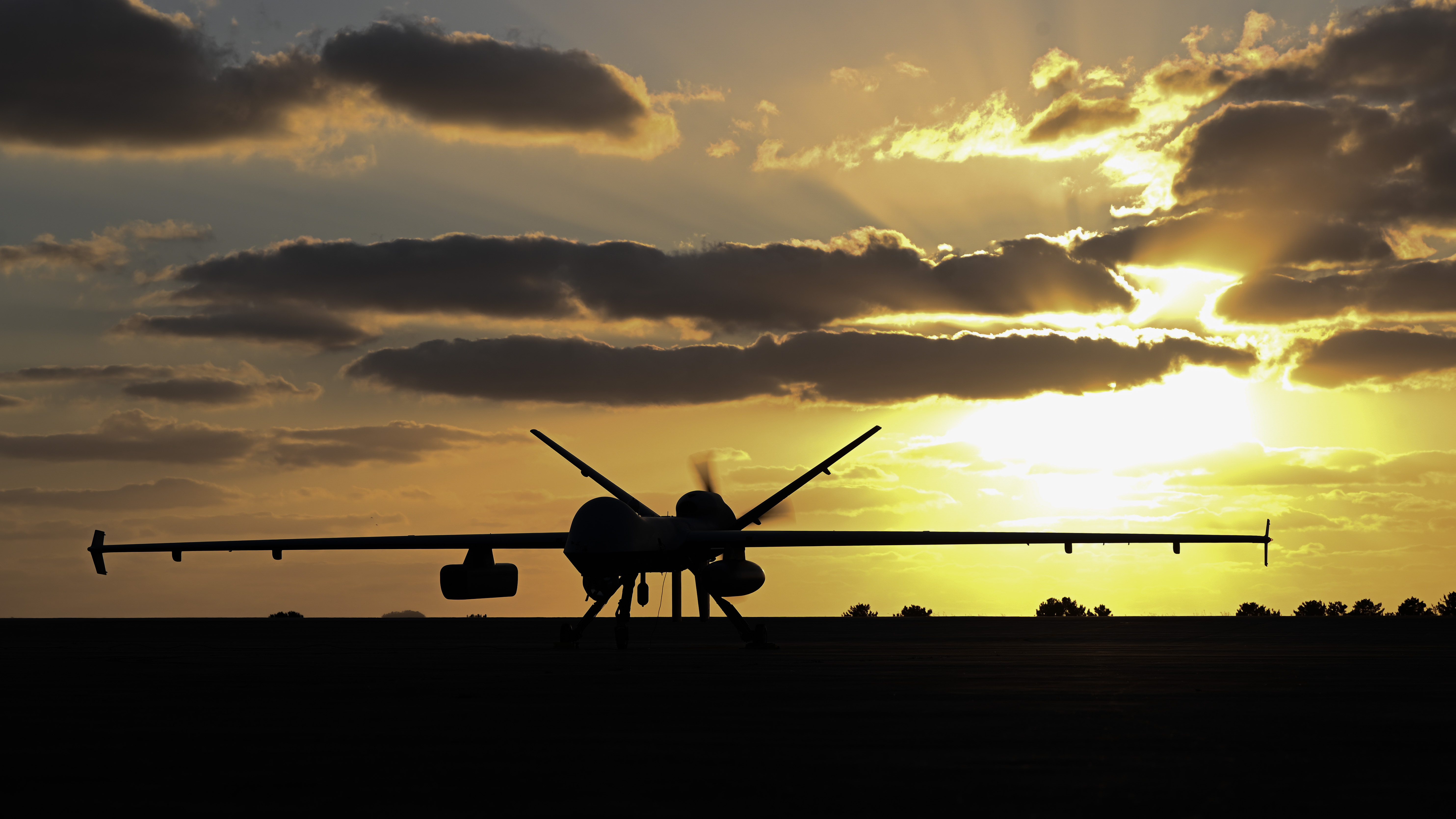
It’s not stealthy, it’s getting up there in years and it doesn’t have the payload of fifth-generation fighter jets. Despite that, the MQ-9 Reaper drone system isn’t going to the bone yard.
In fact, the Reaper is a reliable and frequently used weapon in the U.S. military’s arsenal, popping up among forward-deployed forces in conflict zones around the world. Most recently, the Pentagon revealed it was one of several airframes taking part in the war in Iran, or Operation Epic Fury, as the military calls it. The turbo-prop MQ-9 is flying over the Middle East alongside F-15s, F-16s, F-22s, F-35s and bombers such as the B-2 Spirit. And that’s on top of it increasingly being fielded overseas for intelligence, surveillance and reconnaissance missions. Not bad for an uncrewed aerial system whose glory days are seen as the Global War on Terror and are well behind it.
So why aren’t the MQ-9s being visited by the Grim Reaper? It turns out, because the military just can’t quit it. The longer answer is that the Air Force and Marine Corps are finding new ways to upgrade its capabilities, but in short, the MQ-9 serves a role that isn’t easily replaced.
From the Predator to the Reaper
The Reaper evolved out of the earlier MQ-1 Predator drone, which itself was a game changer for the Air Force. It was, eventually, armed with missiles, it had a long range and because it was a remotely controlled system, the actual operators were far away and not at risk. So naturally the military wanted to take that and make something more potent. Tests on what would become the MQ-9 started in 2001. Finally in 2007, the Air Force officially put the MQ-9 Reaper into operational service. This one is bigger, better, faster, stronger and has more range than the Predator.
It can carry a solid mount of firepower, including up to eight Hellfire missiles, and is often fitted with laser guided bombs such as the GBU-12. But its main role is as an ISR platform. And there’s a good reason why: it has serious endurance. It can fly for nearly two days straight when fitted with an extended range kit — even when fully loaded with weapons it can still be in the air for around 14 hours — operate as high as 50,000 feet up and its standard design includes the Multi?Spectral Targeting System, sensor system that includes infrared, shortwave infrared and a laser designator, among other tools. Even when it’s not directly shooting at something, the Reaper can and is meant to keep an eye on things.
Top Stories This Week
Since entering service, it took part in everything from anti-piracy operations to targeted strikes on militant leaders. But of course, this is still a weapons and ISR platform better known for flying over Afghanistan, not taking part in large-scale conflict and being fielded for peer-on-peer missions. Right?
A second life for an aging weapon
Let’s get a few things out of the way: The MQ-9 has its limitations. Even with all of the power they do have, and the improvements over the Predator, Reapers aren’t the fastest aircraft out there, nor the stealthiest. Radar can and does pick it up. During the more than a year and a half of fighting against Houthi militants in and around Yemen, at least 15 Reapers were shot down. These are ISR platforms first and foremost as well, even with their strike capabilities, they aren’t meant to take on peer forces such as China. The Air Force, like a lot of the military, is shifting its strategy and acquisition to deal with that. As such, it’s focusing on updating fighter squadrons abroad, and developing newer, more powerful uncrewed systems, such as the Collaborative Combat Aircraft (or CCA) program. And other service branches are looking at loitering munitions or similar weapons systems.
But the MQ-9 operates in a kind of “Goldilocks zone.” For all of the flaws listed above, it’s also a capable ISR platform that can fly for extended periods of time and is proven to work in those tasks. While the military is working on developing new generations of weapons, a costly and time consuming endeavor even before it gets into having them replace platforms currently in service, the MQ-9 is reliable. And that’s why its use has expanded, with the Marine Corps fielding Reapers in recent years. The Air Force set up a permanent deployment of MQ-9s in South Korea, reviving a World War II-era squadron for the reconnaissance mission. Marines sent unarmed Reapers to the Philippines as part of ISR missions in the South China Sea. And recently several Reapers were spotted in Puerto Rico, part of the U.S. military buildup in Operation Southern Spear. The MQ-9 gets around.
Marines have started fielding the MQ-9A Block 5 Extended Range aircraft. This variant has fuel pods on the wings, helping boost its flight time to more than 30 hours. They’re also working on addressing the drone’s stealth flaws, adding an electronic warfare and intelligence collection pod that serves both to make it harder to detect and to help map out enemy’s electronic emitters that would fill up a battlefield — think radios, radars, satellites, all of the tools that make modern warfare possible. Then there are the weapons. Defense manufacturers are working to make the MQ-9B capable of fielding and firing the AGM-158 JASSM (Joint Air-to-Surface Standoff Missile) and AGM-158C LRASM (Long Range Anti-Ship Missile), munitions used by strike fighters.
But that’s the Reaper. It wasn’t meant to be revolutionary or hyper specialized. It was meant to be persistent, and despite the ravages of time and changing threats, it is.
For more on why the Reaper just won’t die and why the military keeps finding new uses for it, check out our full video on the Task & Purpose YouTube channel here.

Task & Purpose Video