
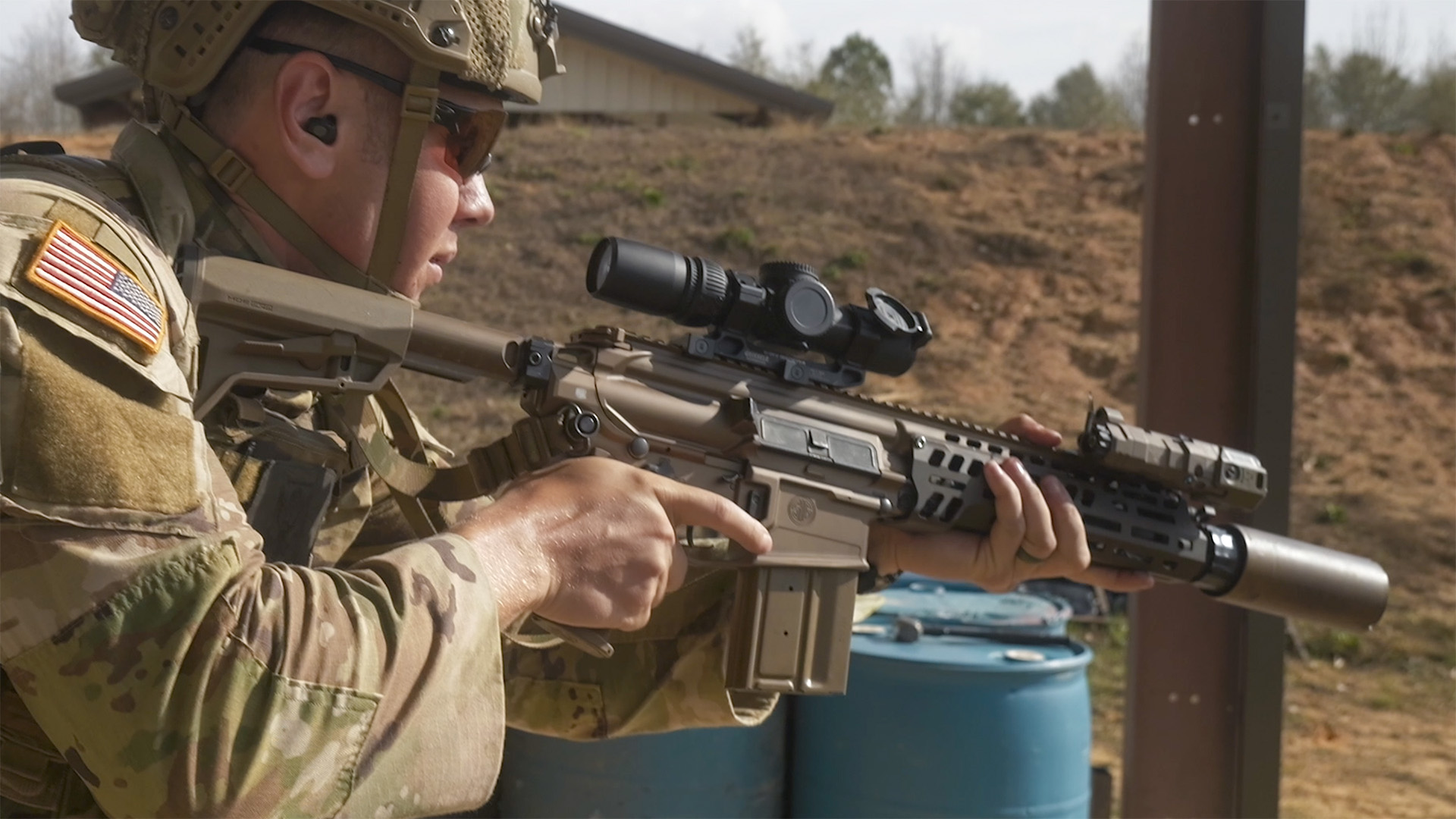
The Army is about to roll out a smaller carbine as part of its new, multi-billion-dollar rifle system. A slightly shorter and lighter carbine version of the M7 rifle, the Army confirmed, is now close enough to fielding that it has been given its own name: the XM8.
Troops tapped for early testing of the new carbine should start to get their hands on the first XM8s as soon as October, an Army spokesperson told Task & Purpose. The XM8 shares internal firing components with the Army’s new M7 rifle, firing a 6.8 x 51mm round.
“A carbine is a compact, lightweight version of a rifle, designed for enhanced maneuverability and ease of handling in confined spaces or vehicles,” the spokesperson said.
The shorter carbine is the latest model in the Army’s Next Generation Squad Weapon program, or NGSW, the Army’s generational effort to retire the venerable M4 and M249 Squad Automatic Weapon among units most likely to see direct close combat.
The Army plans to spend more than $7 billion in the next 10 years to field the NSGW’s two guns with matching suppressors and optics as the primary weapons for units that include infantry, scouts, combat medics, forward observers, combat engineers, and special forces.
Top Stories This Week
Built by Sig Sauer, the NGSW’s M7 and larger M250 were first rolled out to units for initial testing in 2024. But with the XM8, the NGSW has now gone from a pair of firearms to a throuple. The XM8’s design reflects feedback from soldiers and was developed under the label of the M7 PIE, or Product Improvement Effort, said Sig Sauer product manager for rifles and suppressors Joshua Shoemaker.
“It represents their refinements and optimizations based on the initial fielding of the M7,” Shoemaker told Task & Purpose. “We identified several opportunities to improve the handling, decrease the weight, increase the balance, and advance the already improved performance of the system.”
Similar to M16-to-M4 switch
The Army last gave its frontline soldiers a shorter carbine in place of a longer rifle when it largely replaced the M16A4 with the M4 as its standard combat weapon in the first decade of the post-9/11 wars. The Marine Corps followed suit in the mid-2010s.
The XM8 is just over 32 inches long overall, compared to 37 inches for the M7, with a barrel length dropped from 13 to 11 inches and its suppressor from 7 to 6 inches, Shoemaker said.
The carbine is also lighter than the M7, Shoemaker said. Without the suppressor, the XM8 weighs 7.33 pounds while the M7 weighs 8.36 pounds. The carbine’s suppressor shaves down to 1.31 pounds from the M7’s 1.46 pounds.
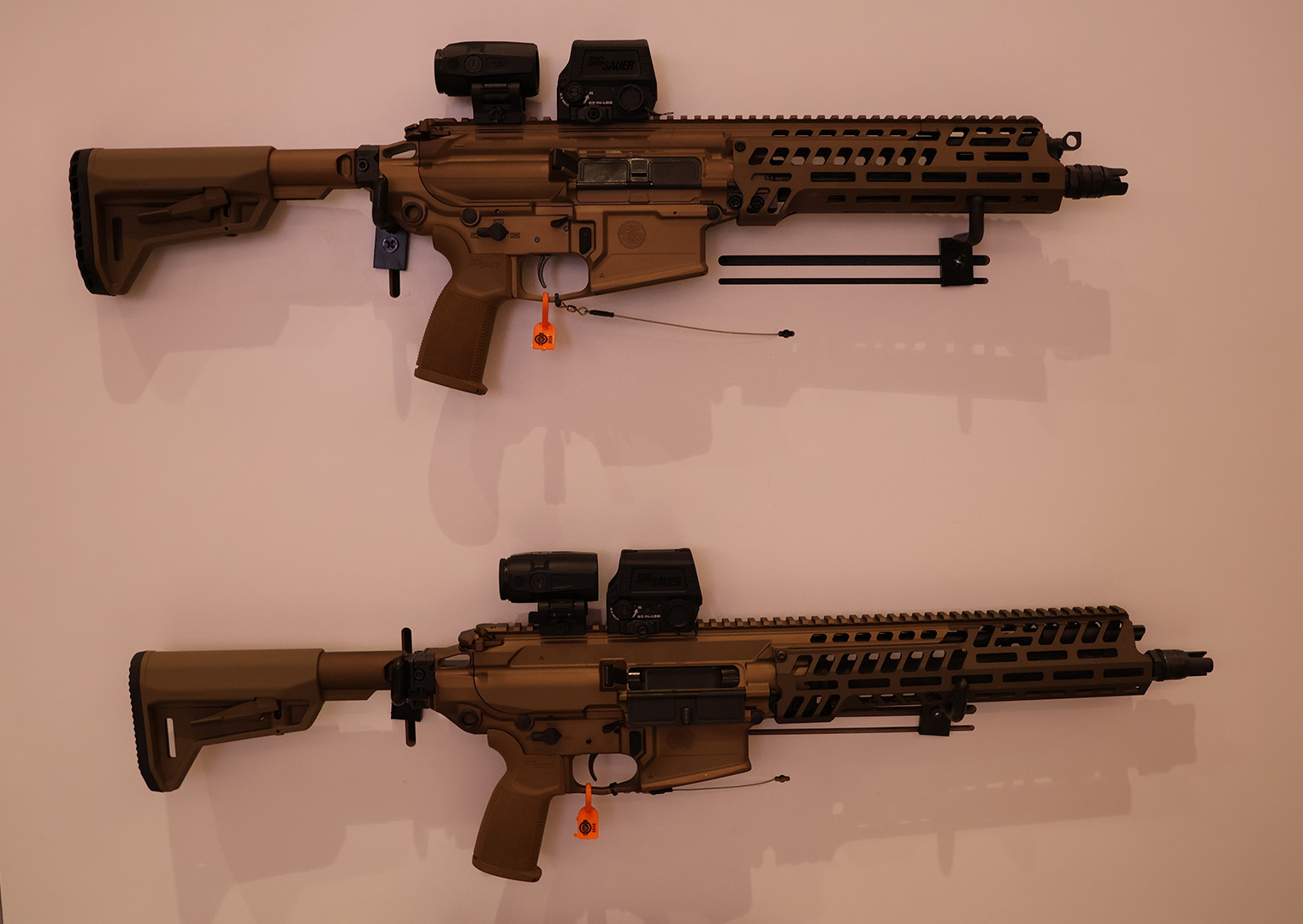
The carbine also comes with a fixed stock after soldiers said they preferred it to the M7’s folding stock, Shoemaker said.
“The folding stock, although a nice feature, is just not as robust as a thick stock will be,” Shoemaker said.
The carbine also has a softer butt pad and a more rigid handguard for optics and other mounted equipment.
“The new XM8 variant delivers an enhanced capability, particularly for roles where a more compact, maneuverable system is advantageous,” Shoemaker said.
Early M7 criticism
The term carbine is, to some extent, one of art rather than science in firearms, but is widely viewed as a compact rifle with a barrel under 20 inches. The M16A4’s barrel, as an example, was 20 inches, while the M4’s is 14.5.
The Army’s efforts to field the XM8 come after an Army officer leveled several criticisms last year against the Next Generation Squad Weapon rifle, then known as the XM7, which he argued showed that the weapon was “unfit for use as a modern service rifle.”
Army Capt. Braden Trent presented the findings of his research into rifles last April during the Modern Day Marine exhibition in Washington, D.C. He said he had found the rifle’s weight made it hard for soldiers to maneuver with it, and its 20-round magazine does not provide soldiers with enough ammunition for combat.
Both the Army and Sig Sauer have disputed Trent’s conclusions.
The Marine Corps has said it will not adopt the M7 in favor of sticking with an updated variation of the M4, the M27 Infantry Automatic Rifle.
“The Marine Corps will retain the M27 for our close combat formations as it best aligns with our unique service requirements, amphibious doctrinal employment of weapons, and distinct modernization priorities, while ensuring seamless interoperability across the Joint force and with coalition partners,” a Marine Corps spokesperson told Task & Purpose in February.

Task & Purpose Video