
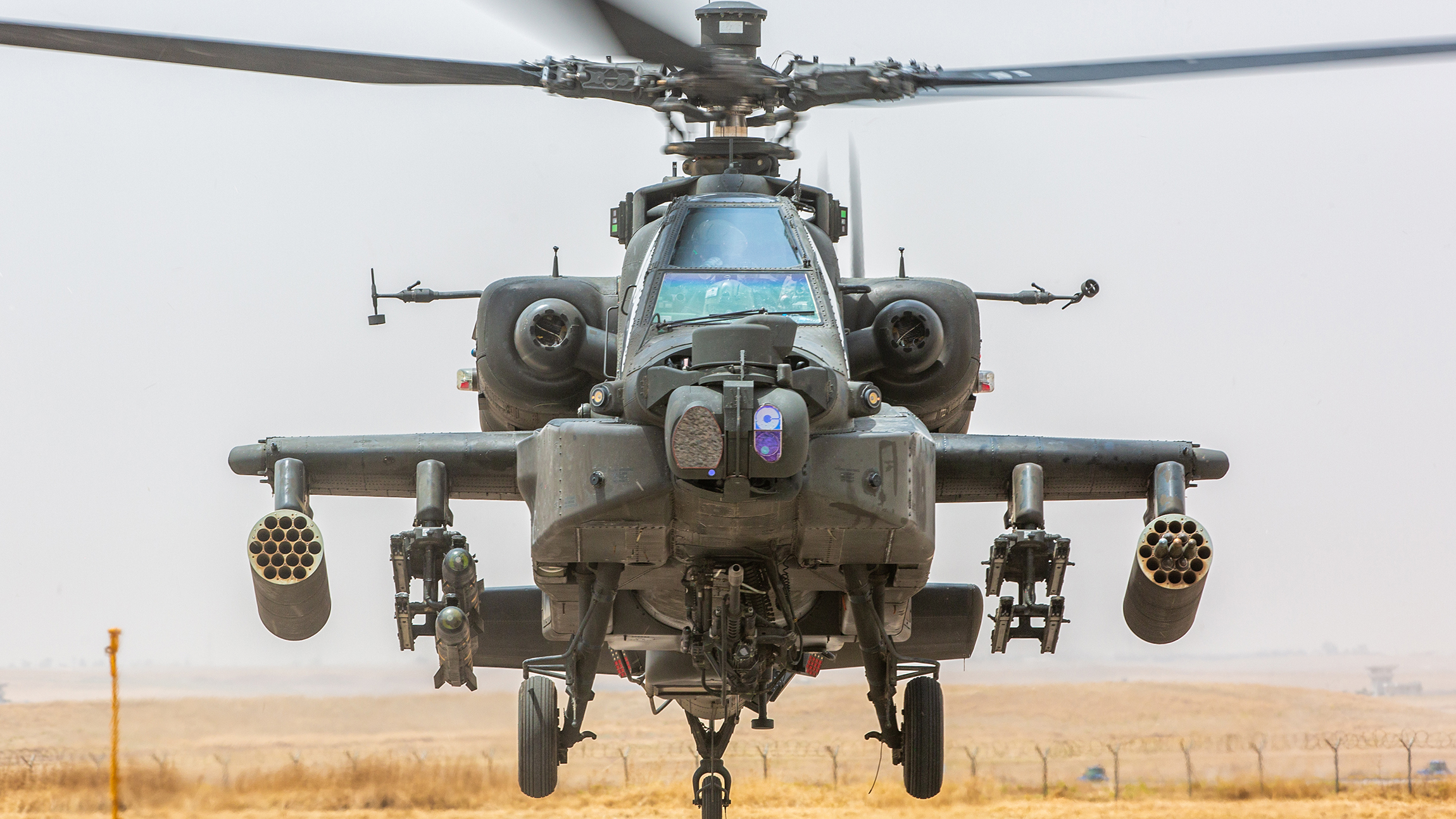
The war against Iran has spread to neighboring Iraq, where a top U.S. general says American Apache attack helicopters are battling Iranian proxies.
“In Iraq, AH-64s [Apache helicopters] have been striking against Iranian-aligned militia groups to make sure that we suppress any threat in Iraq against us, forces or U.S. interests,” Air Force Gen. Dan Caine, Chairman of the Joint Chiefs of Staff, told reporters on Thursday.
Speaking at a Pentagon news conference, Caine did not elaborate on how many combat missions Apache helicopters have flown in Iraq since U.S. operations against Iran on Feb. 28.
Top Stories This Week
Nor did Caine specify which Iranian-backed militia groups U.S. helicopters have attacked.
Since the start of U.S. military operations against Iran, named Operation Epic Fury, the U.S. embassy in Baghdad has been repeatedly attacked by drones and missiles. The embassy issued a statement on Tuesday saying that Iranian-backed militias have “encouraged and conducted widespread attacks on U.S. citizens and targets associated with the United States throughout Iraq,” including attacks on Baghdad’s international zone, where the embassy is located.
For decades, the United States and Iran have been fighting a shadow war that accelerated following the U.S. invasion of Iraq in 2003 to topple Saddam Hussein. The Defense Department has estimated that Iranian-backed groups killed more than 600 U.S. troops in Iraq between 2003 and 2011.
The undeclared war between the two countries has continued throughout the U.S.-led campaign against the Islamic State group, or ISIS, which began in 2014. U.S. troops have battled militia groups supported by Iran, including Kata’ib Hezbollah and Harakat-al-Nujaba. U.S. airstrikes have also targeted facilities used by Iran’s Islamic Revolutionary Guard Corps in the region.
Following Hamas’ Oct. 7, 2023, terror attack on Israel, the Islamic Resistance in Iraq, a network of Iranian-backed groups, began attacking U.S. troops in the Middle East. The group claimed credit for a January 2024 drone attack against a U.S. outpost in Jordan that killed three soldiers.
Also on Thursday, Caine told reporters that the Air Force’s venerable A-10 Thunderbolt II, commonly called the Warthog, is now part of U.S. military efforts to stop Iran from closing the Strait of Hormuz, a strategically important waterway through which about 20% of the world’s oil flows.
“The A-10 Warthog is now in the fight across the southern flank and is hunting and killing fast attack watercraft in the Strait of Hormuz,” Caine said.
Last week, concerns that Iran could try to use sea mines to stop oil tankers from transiting the strait. As of Thursday, the U.S. military had destroyed 44 Iranian vessels used to lay mines, Caine said.
Traditionally, the A-10 has provided life-saving close air support to ground troops, oftentimes during intense battles. Earlier this year, A-10s took part in airstrikes against ISIS in Syria in response to the killings of two soldiers with the Iowa National Guard and a civilian translator in December.
Although the Air Force has repeatedly tried to retire the A-10, Congress has mandated that the service keep 103 of the aircraft through the end of the fiscal year, which runs until Sept. 30.
UPDATE: 3.19.2026; This article was updated after publication to note that Air Force A-10 Thunderbolt IIs are actively engaged in combat operations in the Strait of Hormuz.
Task & Purpose Video