

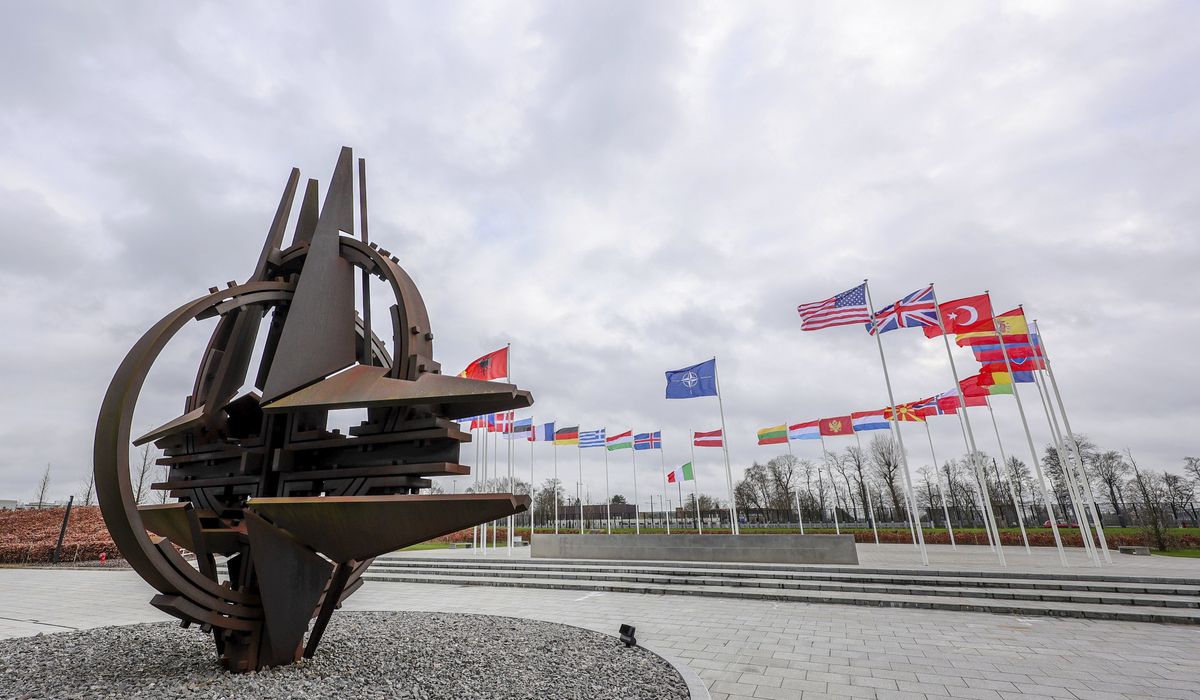
Russia’s military advance on Ukraine is the biggest foreign policy crisis the Biden administration has faced thus far and has cast a harsh spotlight on NATO’s relevance as a pro-democracy European security alliance capable of halting further Russian aggression in the region.
It’s a test that arrives after years of criticism that former President Trump faced for the public and confrontational manner in which he called out major NATO partners for their unwillingness to meet defense spending targets and share the military burden with Washington.
Member spending has inched upward since 2019. But analysts say NATO has been too slow to beef up and modernize to help regional democracies deflect Russian President Vladimir Putin’s increasing aggression — let alone counter the prospect of an authoritarian global military alliance between Russia and China. Mr. Putin, by contrast, has steadily improved Russia’s once-decimated military forces, giving the Kremlin once again the power to project power beyond Russia’s borders.
Analysts say the potential is vast for an alliance of U.S. adversaries to increase their sway over the coming decade in both Europe and Asia, while intimidating fledgling democracies like Ukraine, which itself is not a member of NATO, but is bordered by four alliance members: Romania, Hungary, Slovakia and Poland.
While NATO has expanded to include those four, along with roughly a dozen other Eastern European countries over the past three decades, regional experts say the true size of the alliance’s force structure has actually been shrinking since the end of the Cold War.
“Since the breakup of the former Soviet Union, [NATO] has cut its forces,” says longtime national security expert and former Pentagon official Anthony H. Cordesman. “This is true of the United States and each of the European countries.”
“You have seen a steady decline in European and U.S. capabilities now for something on the order of nearly 20 years,” Mr. Cordesman, a senior analyst with the Center for Strategic and International Studies (CSIS), told C-Span on Tuesday.
His comments came as the Biden administration and NATO scramble to respond to the Ukraine crisis, with NATO Secretary-General Jens Stoltenberg calling Russia’s threat to swallow Ukraine “the most dangerous moment in European security for a generation.” Already off the table, though, is any role for U.S. and alliance soldiers directly confronting Russian forces inside Ukraine, something President Biden has consistently rejected.
Mr. Stoltenberg said NATO stands “in solidarity with the Ukrainian people” and will continue to provide equipment to Ukraine’s military. He also stressed that NATO nations bordering Ukraine can rest assured the alliance will do whatever it takes to shield them from Russian aggression.
Ukraine is Mr. Putin’s immediate target, but the Russian leader has the larger challenge of NATO in his sights. Two of his top demands are that NATO promise never to take in Ukraine as a member and that the Western alliance roll back its troops and weapons from a broad swath of eastern Europe near Russia’s western borders.
Delivering on promises
But questions are swirling around NATO’s actual capability to deliver on those promises. “We have over 100 jets at high alert and there are more than 120 allied ships at sea, from the high north to the Mediterranean,” Mr. Stoltenberg said Tuesday, noting that members have deployed thousands of troops to the alliance’s eastern flank and placed more on standby.
In early February, Mr. Biden ordered 2,000 U.S.-based troops, including elements of the 82nd Airborne Division, to Poland and Germany, and shifted 1,000 other American forces from Germany to Romania. The Pentagon expanded the moves Tuesday, saying 800 troops from a U.S. Army battalion in Italy — likely to be drawn from the 173rd Airborne Brigade — are also being shifted to the Baltics.
Officials added that a battalion of 20 AH-64 helicopters and up to eight U.S. F-35 Strike Fighters in Germany are being shifted to Eastern Europe, with a separate aviation task force consisting of roughly 12 AH-64 helicopters moving from Greece to Poland.
The American personnel and equipment movements are the most dramatic Washington has engaged in Europe in recent memory. They also far outstrip any troop and equipment commitments being made by other NATO members in response to Russia’s moves in the region.
Four Danish F-16 fighter jets arrived in Lithuania in late January to bolster NATO’s air policing mission there, according to Voice of America. NATO countries have deployed roughly 4,500 troops to Estonia, Latvia, Lithuania and Poland since Russia’s forceful annexation of Ukraine’s Crimean Peninsula in 2014.
France also recently announced plans to send several hundred troops to Romania. Germany, the Netherlands and Spain have said only that they’re considering sending troops to NATO’s eastern flank.
Other major members of the alliance have focused on arming and supporting the Ukrainians, with Britain reportedly sending in a team of 30 elite training forces while supplying some 2,000 anti-tank weapons. Turkey, meanwhile, has said it will sell drones to Ukraine, and the two are moving ahead with plans to co-manufacture sophisticated drones, according to Defense News.
But NATO has also found itself repeatedly on its back foot in the latest Ukraine crisis, repeatedly finding itself forced to react to Mr. Putin’s moves, according to former NATO Supreme Allied Commander Gen. Philip M. Breedlove, the alliance’s top military officer from 2013 to 2016 — Moscow “annexed” Crimea from Ukraine.
“Right now, we are in passive deterrence, and Mr. Putin is in active measures,” Gen. Breedlove said in an interview with Air Force Magazine Tuesday. “That’s why I think we see, now, Russians moving into Ukraine.”
Piecemeal
But many regard the NATO response as too piecemeal to deliver the level of deterrence necessary to stare down one of a Russian military wholly focused on its smaller neighbor. Analysts also say NATO’s limitations explain why the Biden administration is so focused on using sanctions — rather than a show of military force — to try to roll back Russia’s aggressive moves.
Retired four-star Army General Jack Keane suggests NATO would be dramatically outmatched if Russia were to threaten other Eastern European nations with anything like the 150,000-plus troops it has massed on Ukraine’s border.
“If [Putin] massed that on any one of the NATO countries that are on his border — Poland, the Baltics — there’s no match for that there,” Mr. Keane said in a Fox News appearance Monday. “That would take a massive deployment to provide that kind of a match for Putin’s capabilities.
Mr. Keane also suggested the U.S. has dropped the ball by failing to push more aggressively for the NATO Response Forces (NRF), consisting of roughly 40,000 multinational troops, as well as air and naval assets, to deploy to the region. “It should be done,” he said. “I’m not suggesting that Putin’s going to move on Poland, but we’ve got to make sure that he understands that we’ve got the determination and resolve to do something about it if he’s thinking about it.”
But mustering such resolve may prove more difficult than officials want to admit. Mr. Trump, for instance, wasn’t the first U.S. president to gripe openly about the failure of NATO allies to spend enough toward upholding the alliance.
Former Presidents George W. Bush and Barack Obama also expressed frustration that America shoulders the lion’s share of the costs, with both pushing for countries such as France, Italy and Germany to meet their defense spending commitments. The efforts, along with Mr. Trump’s push, yielded mixed results.
An analysis published last week by CSIS said the alliance should have been put on high alert following Russia’s 2014 annexation of Crimea, asserting that the U.S. specifically “failed to lead effectively at the presidential level.”
“It failed to effectively rebuild its forward deployed forces and power projection capabilities,” Mr. Cordesman and Grace Hwang, a research assistant at the think tank, wrote in the assessment, which was particularly critical of Mr. Trump’s aggressive approach on the issue of NATO member spending.
Critics have accused the former president of going too far by threatening to pull the U.S. out of the alliance if other members didn’t increase their spending.
“The Trump administration effectively turned U.S. policy toward NATO into a mathematically absurd form of burden-sharing bullying,” wrote Mr. Cordesman and Ms. Hwang. “It pushed America’s European allies to spend more without addressing their many differences, the very different key deficiencies in most member countries’ forces, and their very different shortfalls in modernization and interoperability.”
• Mike Glenn contributed to this article.