
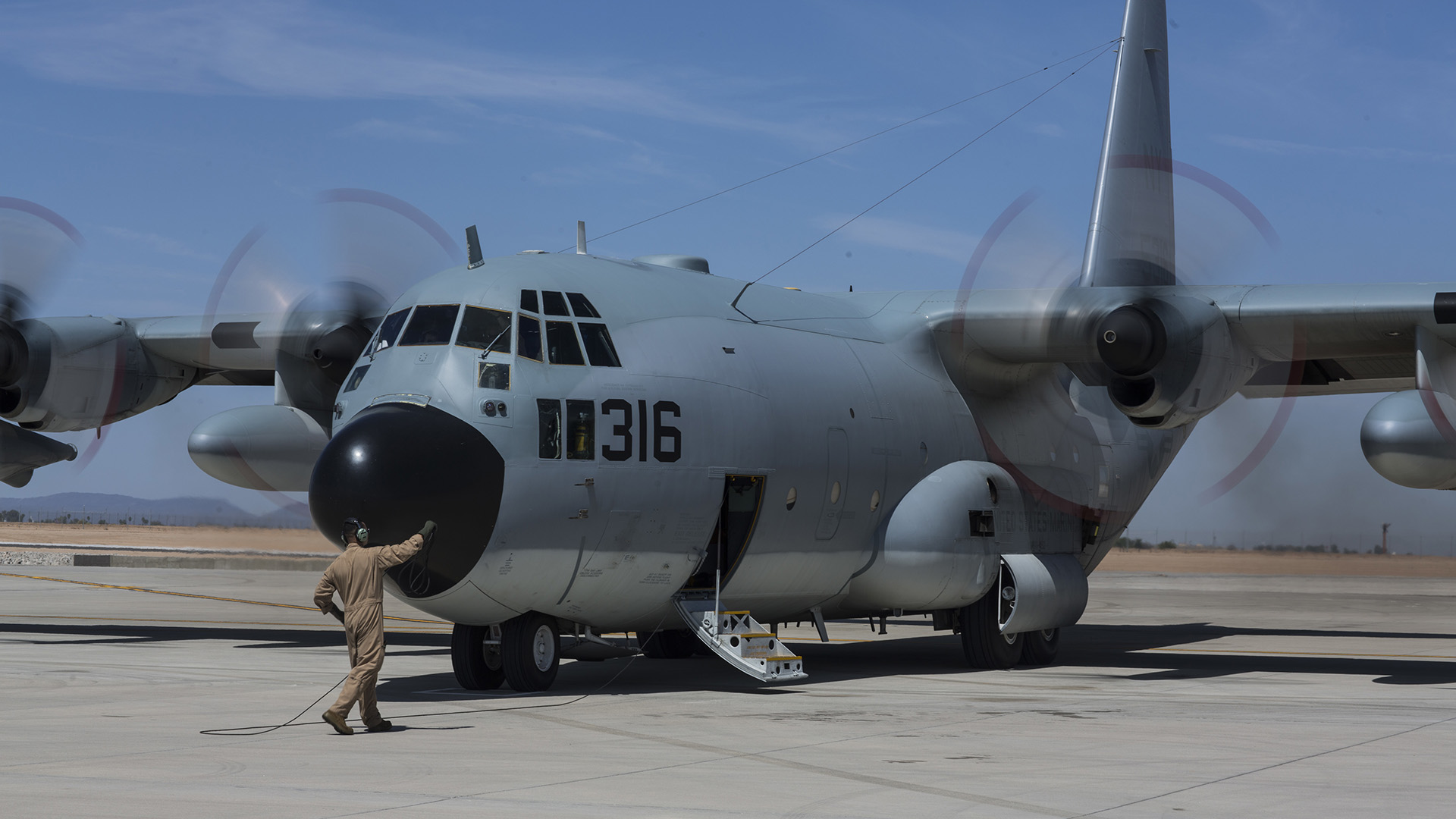
A retired Air Force civilian engineer accused of covering up maintenance issues behind a deadly Marine KC-130T crash was found not guilty by a federal jury earlier this month. The 2017 crash killed all 16 service members aboard.
James Michael Fisher, 69, was acquitted on March 5 of two counts of making false statements and one count of obstruction of justice, court records show. A judge dismissed another count of obstruction of justice against Fisher in December.
Fifteen Marines and one sailor were killed when the KC-130T disintegrated over Mississippi in 2017. Investigators found shoddy maintenance and questionable record keeping in a depot where Fisher worked led to a catastrophic propeller failure that tore the plane apart.
Fisher told Task & Purpose this week he was a “scapegoat” in the case. Federal prosecutors had accused Fisher of withholding documents and making false statements to federal agents in an attempt to cover up his role in waving a type of inspection that could have prevented the crash.
Top Stories This Week
When he was initially indicted in July 2024, the Justice Department announced that Fisher faced a maximum penalty of 20 years in prison if he were convicted.
Speaking to Task & Purpose on Thursday, Fisher described his acquittal as a “huge relief.”
“The reality is, I didn’t do anything wrong,” Fisher said. “When the jury saw all the evidence, and they heard my testimony, you could tell that not only the jury but the judge herself realized what had happened: I was made a scapegoat.”
The KC-130T, flying under the call sign “Yanky 72,” crashed on July 10, 2017, after the plane broke apart at 20,000 feet over Mississippi. All aboard were killed, including seven Marines assigned to the 2nd Raider Battalion.
Military investigators later determined that the crash was caused by a corroded propeller blade that broke free of an engine an tore into the aircraft as it cruised at high altitude. The investigation also found that the problems with the faulty blade had neither been detected nor repaired when it went through the Warner Robins Air Logistics Complex, Georgia, for an inspection and overhaul in August 2011.
Fisher served as the C-130 lead propulsion system engineer at the complex from 2011 to 2022. Federal prosecutors accused him of trying to cover up that he had approved a request from a maintenance supervisor to stop conducting a type of inspection that should have found the cracking in the propeller blade in favor of a less reliable method, according to the indictment against him.
But Steve Farese Sr., one of Fisher’s attorneys, said that Fisher had never approved such a waiver. In fact, someone else, who has yet to be identified, copied and pasted an email from Fisher into the waiver, which was approved by another engineer, Farese told Task & Purpose.
“We were able to show that the document that suspended a safety check process was not approved, not authored, in fact, not even known to Mr. Fisher,” Farese said. “He did not sign the document. He did not see the document.”
Moreover, evidence showed that the waiver did not go into effect until after the propeller blade had been inspected, Farese said.
Fisher told Task & Purpose that it only took jurors little more than an hour to find him not guilty.
“It’s been 20 months that we’ve had this cloud hanging over our head, and it’s going to take a while to recover from it,” Fisher said.
Task & Purpose Video