
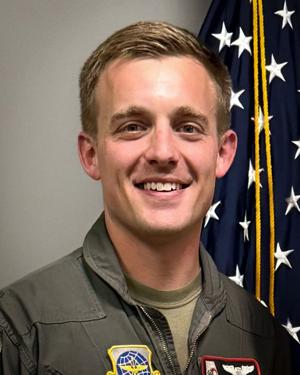
A pilot from Alabama had just been promoted to major in January and had been deployed less than a week when the refueling aircraft he was aboard crashed in Iraq this week, killing him and five others, his brother-in-law said Saturday.
Alex Klinner, 33, leaves behind three small children: 7-month-old twins and a 2-year-old son, his brother-in-law, James Harrill, said Saturday while confirming his death.
“It’s kind of heartbreaking to say: He was just a really good dad and really loved his family a lot — like a lot,” Harrill said.
Klinner was one of three people killed in the Thursday crash who the U.S. government said were assigned to the 6th Air Refueling Wing at MacDill Air Force Base in Florida and who Alabama Gov. Kay Ivey said were stationed in Birmingham. On Saturday, the U.S. government identified the other two as Capt. Ariana Savino, 31, of Covington, Washington, and Tech. Sgt. Ashley Pruitt, 34, of Bardstown, Kentucky.
Three additional deceased service members on the aircraft were assigned to the 121st Air Refueling Wing at Rickenbacker Air National Guard Base in Columbus, Ohio. They were identified by federal and state officials as Capt. Seth Koval, 38, Capt. Curtis Angst, 30, and Tech. Sgt. Tyler Simmons, 28.
The U.S. government listed Koval from Mooresville, Indiana, while the Ohio National Guard listed his home Stoutsville, Ohio. The Ohio National Guard listed both Angst and Simmons from Columbus, Ohio, while the U.S. government listed Angst as from Wilmington, Ohio.
The aircraft was in “friendly” airspace, supporting operations against Iran, when an unspecified incident involving another aircraft occurred, according to U.S. Central Command. The other plane landed safety, U.S. military officials said.
A new father and a new major
Klinner, a graduate of Auburn University and an eight-year U.S. Air Force veteran from Birmingham, Alabama, had just moved with his family into a new home, his wife, Libby Klinner, said in an Instagram post mourning his death.
An outdoorsman who enjoyed hiking, Klinner was also ready to help others. When Harrill last saw him in January, Klinner had shoveled Harrill’s vehicle out of the snow during a family wedding.
“Alex was one of those guys that had this steady command about him,” said Harrill, of Atlanta, who helped set up a GoFundMe site for Klinner’s family. “He was literally one of the most kindest, giving people.”
Libby Klinner said in a post that her heart is broken for their children, who will grow up not knowing their father.
“They won’t get to see firsthand the way he would jump up to help in any way he could,” she wrote. “They won’t see how goofy and funny he was. They won’t witness his selflessness, the way he thought about everyone else before himself. They won’t get to feel the deep love he had for them.”
A man with a ready smile
Simmons was a boom operator responsible for transferring fuel from the tanker to the receiving aircraft, according to his Air Force biography.
His mother, Cheryl Simmons, said Saturday that she was making funeral plans for her son.
In a statement obtained by WCMH-TV in Columbus, Tyler Simmons’ family said it was saddened beyond measure to hear of the fatal crash.
“Tyler’s smile could light up any room, his strong presence would fill it. His parents, grandparents, family and friends are grief stricken for the loss of life,” they said.
The Ohio National Guard said Koval was an aircraft commander with 19 years of service. A graduate of Purdue University, he served in the Indiana National Guard before transferring to an Ohio unit in 2017, according to his Air Force biography.
Angst was a pilot with 10 years of service who graduated from the University of Cincinnati, according to his Air Force biography provided by the Ohio National Guard.
The refueling aircraft is a mainstay in the US military
U.S. Central Command, which oversees the Middle East, has said the crash occurred on a combat mission but was over “friendly” territory in western Iraq. Military officials said it is being investigated and was “not due to hostile or friendly fire.”
The KC-135 aircraft refuels other planes in midair, allowing them to fly longer distances and sustain operations without landing. The plane can also be used to transport wounded personnel and conduct surveillance missions, according to military experts.
The Congressional Research Service says the Air Force last year had 376 KC-135s, including 151 on active duty, 163 in the Air National Guard and 62 in the Air Force Reserve. It has been in service for more than 60 years.