
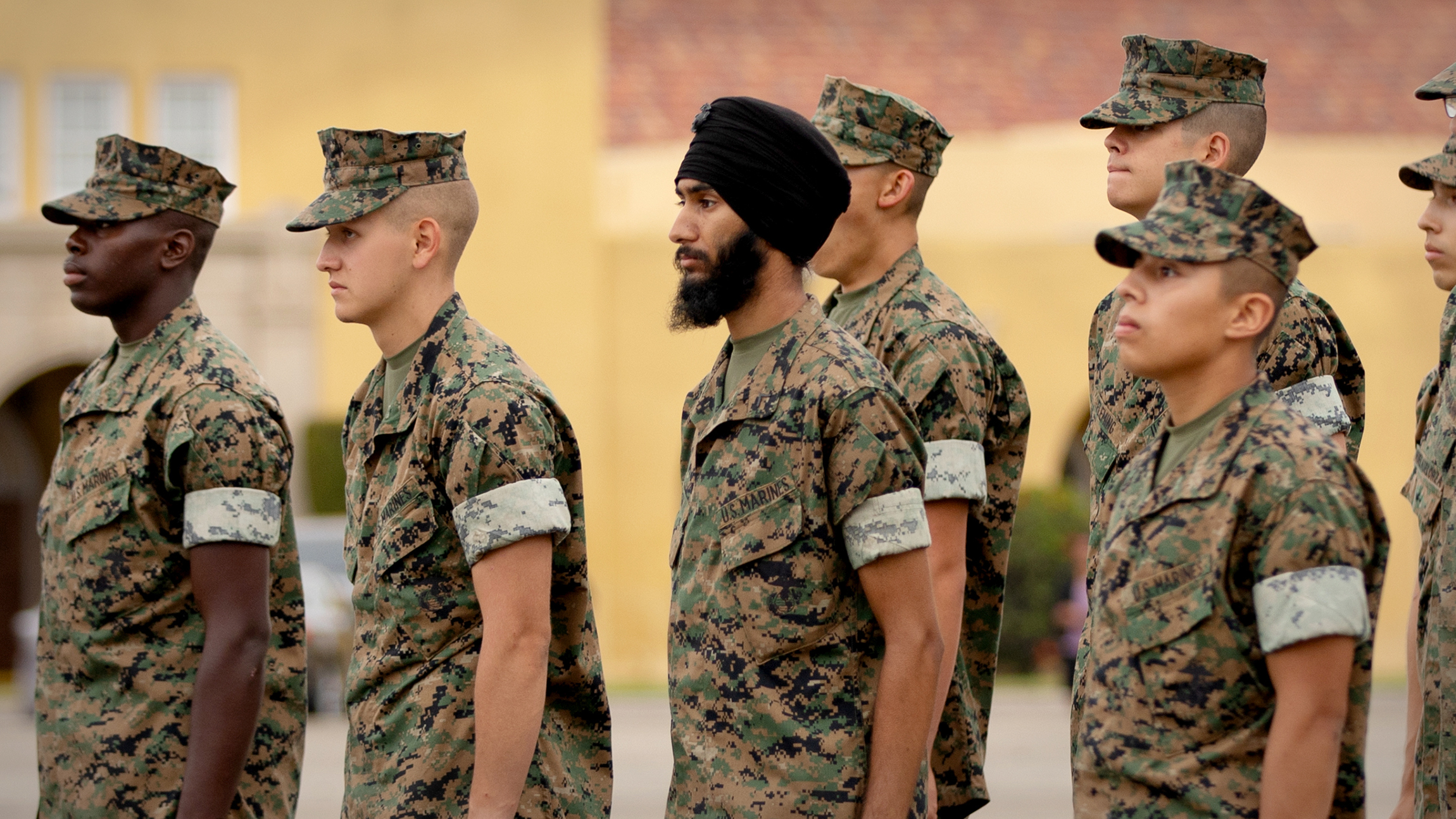
Troops seeking religious waivers for beards will now have to prove to senior military service officials that they have sincerely held beliefs that require they grow their facial hair. The new military-wide policy imposes new requirements for both submitting and approving requests for such waivers, and adds new steps for a troop’s direct commanders and supervisors to weigh in on the requests.
The new memo also adds a requirement of a sworn statement of religious faith, with a warning that a false claim could result in “disciplinary action” under the Uniform Code of Military Justice.
For years, the military has granted waivers to shaving rules as religious accommodations to service members from faiths including Sikh, Muslim, Christian, and Norse Pagan. But in September, Defense Secretary Pete Hegseth indicated to hundreds of generals and admirals that he was skeptical about religious waivers.
“We don’t have a military full of Nordic Pagans,” Hegseth said during a speech in Quantico, Virginia. “But unfortunately, we have had leaders who either refused to call B.S. and enforce standards, or leaders who felt that they were not allowed to enforce standards. Both are unacceptable.”
Top Stories This Week
On March 11, Hegseth released a memo that appears to significantly raise the requirements under which troops can apply for religious accommodations for beards. After it was posted on the unofficial Army subreddit on Tuesday, a Pentagon official confirmed to Task & Purpose that the memo is authentic.
All currently approved religious waivers for beards must be reevaluated under the new guidelines within 90 days, the memo says.
The new policy appears to increase the scope of reasons that local leaders can cite to support or oppose a waiver, while moving the bar for a waiver’s approval into the upper reaches of military leadership.
A waiver, the memo says, must be approved by military department secretaries, with that authority delegated no lower than the chief of personnel for each service. However, the application must go through several layers of lower-level officials before it reaches the decision maker, including an applicant’s local commander.
And a member’s “first-line supervisors” and unit commanders will have more leeway to add input, including their view of “contradictory or inconsistent statements and conduct, and any evidence suggesting that the request may be based on personal preference or convenience,” according to the memo.
Troops must provide sworn statements and other supporting evidence to prove that their religious beliefs include growing beards, the memo says.
“False statements may be subject to disciplinary action under Article 107 of the Uniform Code of Military Justice, or denial of accession, as appropriate,” the memo says.
Unit commanders are required to submit a description of the jobs that troops requesting religious waivers for beards perform, including the likelihood that they will need to wear masks, helmets, firefighting respirators, and other protective equipment, according to the memo.
Commanders must also include all information about the “operational impact of an accommodation,” including an explanation from a subject matter expert of how such a waiver would affect mission readiness, safety implications, and the “feasibility of alternative accommodations,” an attachment to the memo says.
Those making the decision on such waivers must consider input from troops’ first-line supervisors on the “character of the individual and adherence to service values,” according to the memo.
The military branches have until early April to implement the new guidance in each service, the memo says.
Sincerely held beliefs
Since 2009, some Sikhs have been granted waivers to have beards while serving in the military. It is unclear how the new policy will affect them, said Marissa Rossetti, senior staff attorney for the Sikh Coalition, a group that has advocated for Sikhs in the military who want to wear turbans, beards, and other visible signs of their faith.
Two of the biggest changes in the new policy are the requirements for troops to submit sworn statements and commanders to describe how granting religious waivers would affect their unit’s mission, Rossetti told Task & Purpose.
“I think ultimately this is a lot stricter, and I do think we won’t know exactly how it plays out until it is implemented on the ground,” Rossetti said.
While it remains to be seen exactly how requests for religious waivers will be evaluated, Sikhs should have no issue proving the sincerity of their religious beliefs, she said.
“The Sikh belief is that facial hair really is an article of faith, and for a lot of Sikhs, they would rather die than shave their facial hair,” Rossetti said. “It’s something that, for them, is of utmost importance to their beliefs.”
Task & Purpose Video